SMED in Injection Molding: The Complete Guide to Reducing Mold Change Time
SMED is one of the most powerful efficiency tools in modern manufacturing, and a critical competitive differentiator in the injection molding industry. As demand for smaller, more diversified product runs continues to grow—driven by mass customization trends—the ability to switch molds quickly has become a key factor in operational profitability.
SMED (Single Minute Exchange of Die) is a Lean methodology that has revolutionized the way companies manage mold changeovers, turning what used to take hours into a matter of minutes. The analogy is perfect: think of Formula 1 pit stops, where meticulous planning, coordination, and precise execution allow a full tire change in under 3 seconds.
What is SMED in Injection Molding?
SMED, which stands for Single Minute Exchange of Die, is a methodology developed within the Toyota Production System (TPS) designed to drastically reduce equipment setup and changeover time. Despite the name implying one minute, the actual target is to achieve changeovers in single-digit minutes — that is, fewer than 10 minutes.
For injection molding, this means minimizing machine downtime between production runs: from the last good part of the previous mold to the first good part of the new mold. Every minute of downtime is a minute of lost productive capacity — and in plants running dozens or hundreds of machines across continuous shifts, that impact compounds significantly.
SMED is not only about the physical mold swap. It also encompasses material preparation, system preheating, tooling organization, and parameter verification — everything that enables a faster, higher-quality startup from the very first shot.
History of SMED: Shigeo Shingo and Toyota
SMED was developed by Japanese industrial engineer Shigeo Shingo in the 1960s and early 1970s as a cornerstone of the Toyota Production System. Shingo, a Toyota consultant, observed the extremely long setup times on stamping presses and set out to reduce them drastically.
His initial goal was to achieve changeovers in under 10 minutes — hence the term single minute (single digit). The results exceeded all expectations: Toyota achieved changeovers on presses exceeding 1,000 tons in under 3 minutes, a milestone that revolutionized global manufacturing efficiency.
Shingo's philosophy was rooted in the idea that any operation can be optimized through systematic identification and elimination of waste. In 1985, he published A Revolution in Manufacturing: The SMED System (Productivity Press), which became the definitive reference manual for implementing this methodology worldwide.
The 4 Fundamental Principles of SMED
SMED implementation is based on four key steps proposed by Shigeo Shingo:
1. Separate Internal and External Activities
The first principle is clearly distinguishing between two types of activities:
- Internal activities: Can only be performed when the machine is stopped. Examples: mold disassembly and installation, hydraulic/electrical/electronic connections, injection parameter adjustments.
- External activities: Can be performed while the machine is running or before it is stopped. Examples: preparing the next mold, preheating, tooling organization, plastic material preparation, purging the feed system.
2. Convert Internal Activities to External
This is the core of SMED's effectiveness. Once activities are identified, the next step is to creatively transform as many internal activities as possible into external ones:
- Mold preheating outside the machine using external Temperature Control Units (TCUs)
- Mold change carts or tables to pre-position the incoming mold near the machine
- Quick-connect couplings on hydraulic, pneumatic, and electrical systems
- Material purging started before changeover when switching resins
3. Rationalize Remaining Internal Activities
Internal activities that cannot be converted to external must be made as fast and efficient as possible:
- Quick-clamp systems (hydraulic, magnetic, bayonet) instead of conventional bolts and nuts
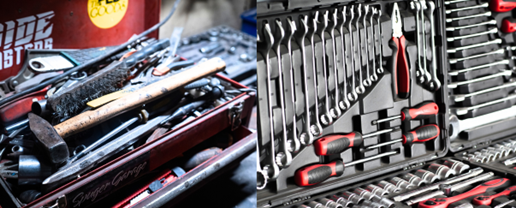
- Tool standardization: only necessary tools, in the right location
- Minimizing adjustments: design molds and processes requiring minimal post-installation fine-tuning
- Parallel work: two or more operators performing activities simultaneously
4. Standardize and Document the Process
Once improvements are implemented, documenting the new procedures is essential: standard operating procedures (SOPs), checklists, training videos, and parameter sheets. This ensures consistency, facilitates training, and provides the baseline for future continuous improvement.
Step 1: Separating Internal and External Activities
Activity separation is the starting point of every SMED process. In practice, many injection molding plants perform external activities with the machine stopped — simply due to lack of planning. This habit can double or triple changeover time unnecessarily.
To correctly identify each type of activity:
- Record a complete video of the changeover process from start to finish
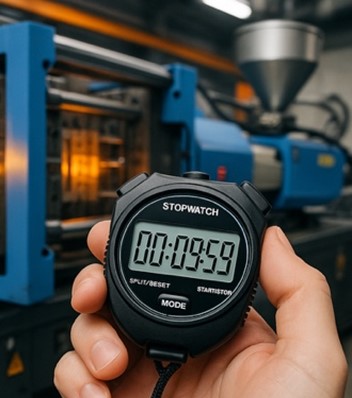
- Time each step individually with a stopwatch
- Draw a spaghetti diagram to visualize team routes and movements
- Review the video with the operations team for objective classification
Typical activities incorrectly performed as internal but that can be external:
- Searching for tools and accessories
- Transporting the mold from storage to the machine
- Preparing and drying plastic material
- Reviewing parameter sheets for the new mold
- Cleaning the work area around the machine
Step 2: Converting Internal Activities to External
This step requires creativity and strategic investment. The most impactful conversions in injection molding plants include:
Mold preheating: Using an external TCU to bring the mold to its operating temperature before installation eliminates the thermal stabilization time post-mounting, which can take 15-45 minutes on complex molds.
Quick-connect couplings: Replacing threaded connections with quick-connects on water, air, and hydraulic lines can reduce connection time from 15-20 minutes to 2-3 minutes.
Material preparation: If the next job uses a different resin, starting the plasticizing unit purge while the machine produces the last pieces of the previous batch converts this from an internal to a partially external activity.
Dedicated tooling kits: Having a dedicated tool cart for each changeover, prepared with everything needed before the changeover begins, eliminates search time entirely.
Step 3: Rationalizing Internal Activities
Activities that inevitably require the machine stopped must be executed with maximum efficiency:
Quick-clamp systems: Magnetic mold clamping systems (like those from Stäubli or Kosmek) allow mold fixing and release in seconds, versus the 10-30 minutes taken by conventional bolt systems.
Assisted positioning: Integrated rollers in platens, sliding tables, or quick-change cranes facilitate physical mold movement in and out of the machine.
Optimized sequences: Reorganizing step order to eliminate redundant movements and allow parallelism between two operators can reduce internal activity time by up to 40%.
Eliminating adjustments: Designing or redesigning molds with standardized heights, fixed reference positions, and connections in predefined locations minimizes post-installation adjustments.
Step 4: Standardize and Document
Improvement without standardization is temporary. Documentation must include:
- Standard Operating Procedures (SOPs) with step-by-step instructions and photos
- Checklists for external and internal activities
- Training videos showing the optimal sequence
- Parameter sheets specific to each mold and material
- KPIs to monitor changeover time over time
Practical Implementation in an Injection Molding Plant
A successful SMED plant implementation follows these phases:
Phase 1 — Diagnosis: Record and analyze at least 5 different mold changeovers. Identify the current average time (baseline) and main causes of time loss.
Phase 2 — Kaizen Workshop: Bring together the team (operators, technicians, engineers, maintenance) to analyze videos, classify activities, and propose improvements. Periodic Kaizen/SMED events are standard practice at large-scale operations targeting specific mold and machine characteristics.
Phase 3 — Pilot: Implement improvements on one pilot machine or process. Measure the new changeover time and compare with the baseline.
Phase 4 — Expansion: Replicate validated improvements across the entire plant. Train all operators in the new procedures.
Phase 5 — Continuous Improvement: Monitor changeover times continuously. Set new targets and repeat the cycle.
Tools and Technology for SMED
The current market offers technological solutions that accelerate SMED implementation:
- Quick Mold Change (QMC) systems: Magnetic, hydraulic, or bayonet
- Temperature Control Units (TCUs): For external mold preheating
- MES (Manufacturing Execution Systems) software: For planning and monitoring mold changes
- 5S Methodology: Sort, Set in Order, Shine, Standardize, Sustain — fundamental for reducing search times
- Video analysis cameras and software: For identifying motion waste
- Robots or cobots for changeover assistance: In highly automated plants
Measurable Benefits: Time, Cost, Quality
| Metric | Before SMED | After SMED | Typical Improvement |
|---|---|---|---|
| Mold changeover time | 2-4 hours | 15-45 minutes | 70-90% |
| Defective parts at startup | 50-200 parts | 5-20 parts | 80-90% |
| Machine utilization | 65-75% | 85-95% | +15-25% |
| Minimum profitable lot size | Large | Small | Flexibility |
| Work-in-process inventory (WIP) | High | Low | -30-50% |
| Changeover accidents | Variable | Reduced | -40-60% |

Success Cases and Typical Results
Numerous injection molding companies have reported dramatic changeover time reductions thanks to SMED:
Case 1 — Bottle cap manufacturer: Reduced mold changeover time from 2 hours to 15 minutes, enabling smaller orders and a more diversified product portfolio without sacrificing profitability.
Case 2 — Automotive plastic supplier: Implemented magnetic clamping systems and quick-connects on 20 machines, reducing average changeover from 90 to 22 minutes and increasing effective production capacity by 18%.
Case 3 — Toyota (historical reference): The case that inspired the methodology: changeovers on stamping presses exceeding 1,000 tons accomplished in under 3 minutes via SMED.
Typical industry result: Companies that correctly implement SMED report 70-90% reductions in changeover time within the first 6-12 months of implementation.
Material Considerations: Thermoplastics vs. Thermosets
Although SMED focuses primarily on the physical mold change process, material selection and preparation also play a fundamental role in time optimization:
Thermoplastics (most common in injection molding)
Polypropylene, Polyethylene, ABS, Nylon, Polycarbonate and similar materials allow recycling of leftover or defective material. Material changes may require a complete screw purge to avoid cross-contamination. Purge time is a key element to account for within SMED.
- Semicrystalline (PP, PE, PA, PET): defined melting point. Purging may take longer when switching to materials with very different processing temperatures.
- Amorphous (PS, PC, ABS, PVC): gradually soften on heating. Purging between amorphous materials at similar temperatures can be faster.
Thermosets (less common in injection molding)
Phenolic, epoxy, unsaturated polyester resins: cure with heat and cannot be remelted or recycled. Managing these during mold changes can be complex due to the need to completely clean the injection unit to prevent residual material polymerization.
Practical recommendation: Anticipating material preparation is a key external activity. This includes having the material dry, preheated if necessary, and the dosing equipment clean and ready for the new material — before stopping the machine.
Conclusion
SMED is far more than a technique to reduce mold changeover time. It is a continuous improvement philosophy that transforms how injection molding plants manage their resources, time, and human talent.
By converting what was once a bottleneck into an agile, standardized flow, companies unlock significant potential for productivity, flexibility, and profitability. From a sustainability standpoint, SMED also contributes to reducing material waste, energy consumption, and inefficient use of machinery.
It's not just about being faster — it's about being smarter in how resources and time are managed. SMED implementation requires initial commitment, but delivers substantial long-term rewards, enabling injection molding companies to not merely survive, but thrive in an increasingly demanding market.
Join MoldingHub: The Global Injection Molding Community
Want to go deeper into SMED and other Lean techniques for your plant? MoldingHub is the professional social network designed specifically for the injection molding industry.
Connect with engineers, technicians, and specialists from around the world who are implementing SMED, optimizing processes, and sharing real technical knowledge. Access tutorials, success stories, calculation tools, and an active community that speaks your language.
In the plastics industry, shared knowledge is the most powerful competitive advantage.