Asaclean: The Ultimate Purging Compound for Injection Molding
In the injection molding and plastic extrusion industry, one of the greatest operational challenges is efficient machine cleaning during color changes, material transitions, and planned shutdowns. Asaclean, developed by Asahi Kasei, has established itself as the world's reference purging compound thanks to its dual mechanical and chemical action. In this article, you'll find everything you need to know about Asaclean: its history, how it works, available grades, real-world use cases, and the economic benefits it brings to your plant.
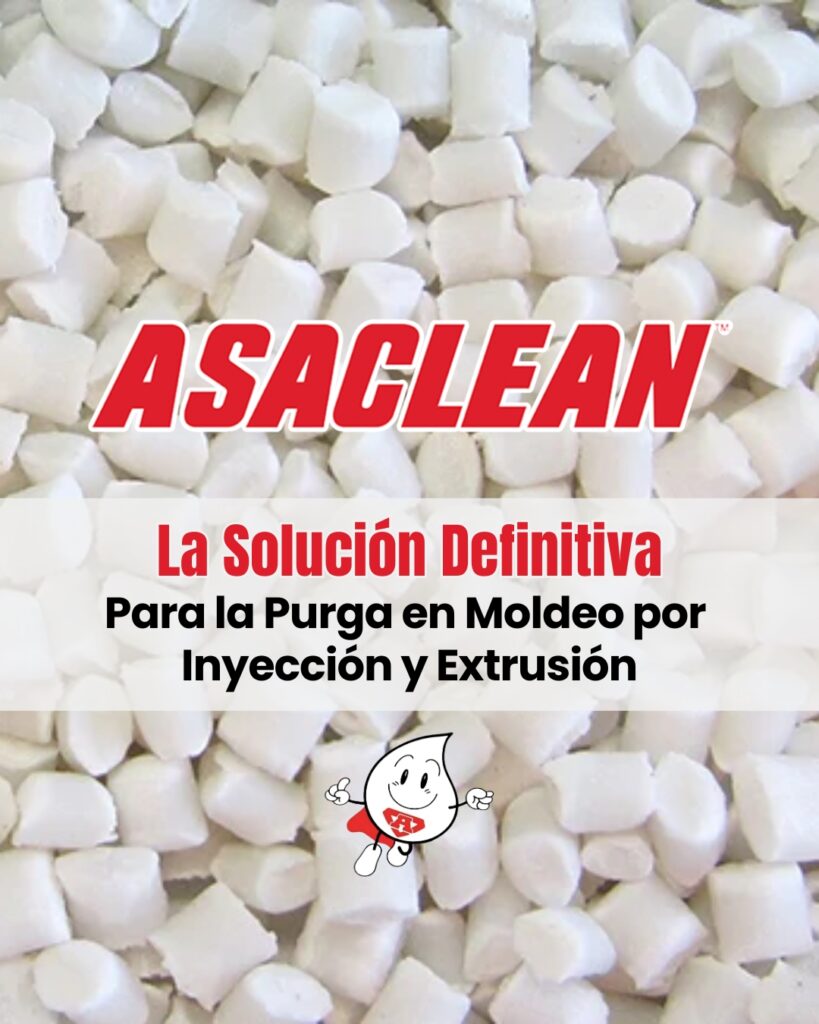
What is a purging compound?
A purging compound is a specially formulated plastic resin designed to clean the internal surfaces of plastic processing machinery: barrels, screws, hot runners, and nozzles. Unlike using virgin resin to purge —which generates enormous amounts of waste and lost time— purging compounds work in a specific and efficient manner.
The main problems they solve include:
- Black spots and streaks caused by degraded and carbonized material on barrel walls.
- Color streaks produced by pigment residues from the previous production run.
- Extended downtime due to manual screw cleaning.
- Defective startups after extended shutdowns with trapped degraded material.
Using a high-quality purging compound like Asaclean allows you to make material and color changes in a fraction of the time, with much less resin waste and without needing to dismantle the screw in most cases.
History and development of Asaclean
Asaclean was developed in 1990 by Asahi Kasei, a Japanese multinational with decades of experience in high-performance materials. The objective was clear: to create a compound capable of efficiently cleaning injection molding and extrusion machines, drastically reducing downtime from color and material changes.
Since its launch, Asaclean has continuously evolved, expanding its product range to cover the full spectrum of processing temperatures —from commodity resins to ultra-high-temperature engineering polymers like PEEK and PEI. Today, Sun Plastech, Inc. serves as the exclusive distributor of Asaclean in North and South America, providing specialized technical support throughout the continent.
The history of Asaclean is also the history of the evolution of the cleaning standard in the plastics industry: from artisanal purges with low-density polyethylene to state-of-the-art compounds with controlled chemical action.
How it works: mechanical and chemical action
Asaclean's effectiveness is based on a dual-action system that differentiates it from a simple virgin resin purge:
Mechanical action
Asaclean's mechanical grades contain high molecular weight polymers that generate controlled, uniform friction against the internal walls of the barrel and screw. This scraping effect physically removes deposits of degraded material and color residues that adhere to metal surfaces. The key is that the cleaning force is sufficient to dislodge deposits without damaging the machine surfaces.
Chemical action
Chemical grades and some mixed grades incorporate foaming additives that activate at temperature. When the compound reaches processing temperature, these additives generate microscopic bubbles that penetrate the micro-imperfections of the internal surfaces —cracks, porosities, accumulation zones— where mechanical action alone cannot reach. This chemical action is especially valuable for eliminating deep carbonization and high-heat-resistant pigments.
The combination of both actions makes it possible to clean the plasticizing system completely and in far fewer cycles than with virgin resin, translating directly into savings in time, material, and money.
Grades and product variants
Asaclean offers a wide range of grades to suit every application, processing temperature, and type of contamination. Below is a comparative table:
| Grade | Type | Temperature range | Main application |
|---|---|---|---|
| E | Mechanical | Low-medium | Temperature-sensitive resins, fast color/material changes, shutdown sealing |
| EX | Mechanical | Medium-high | Maximum mechanical cleaning power, removes carbon deposits, minimal residue |
| PF | Mechanical | Up to 420 °C | Hot runners, sealing between 280-370 °C, high-temperature resins |
| PX2 | Mechanical | Up to 420 °C | Most powerful high-temperature grade, difficult-to-clean resins |
| C | Mechanical | General | Basic color and material changes, economical use |
| CP | Mechanical | General | Polypropylene and polyethylene, hot runners |
| U | Mechanical | General | Versatile high performance, color and material changes |
| UF2 | Mechanical | General | Injection molding, extrusion, blown film extrusion |
| UP | Mechanical | General | PP and PE, fast hot runner purging |
| NF | Mechanical | Medium-high | Superior cleaning with glass fill, removes carbon and stubborn stains |
| NB | Expanding mechanical | Medium | Polyethylene base, foam action, economical solution |
| AG | Mechanical | Medium | Olefins, color changes and contamination elimination in extrusion/injection |
| NH | Mechanical | Medium | Hot runner channel cleaning, injection and blow molding |
| NCR | Chemical | Up to 360 °C | Versatile, covers commodity and engineering resins, eliminates need for multiple grades |
Selecting the right grade
Choosing the correct grade depends on three main factors:
- Processing temperature: High-temperature resins (PEEK, PEI, PSU) require PF or PX2.
- Type of contamination: Severe carbonization → EX or NF; standard color change → E, U, or NCR.
- Machine system: Hot runners → NH or PF; blown film extrusion → UF2 or UP.
When and how to use Asaclean
Asaclean can be used in three major operational scenarios:
Color or material change
- Empty the barrel of production material at normal processing temperature.
- Introduce the appropriate Asaclean grade and process in short cycles until the extrudate comes out clean and color-free.
- Purge with the next job's resin to remove Asaclean residues before starting production.
Machine shutdown (sealing)
- At end of production, purge the barrel with Asaclean to clean it.
- Leave Asaclean in the barrel as a protective seal —its viscosity prevents oxidation and degradation of residual material during shutdown.
- On restart, briefly purge with new production resin to displace the Asaclean seal.
Screw dismounting and cleaning
- Perform a pre-purge with Asaclean before dismounting the screw.
- This softens and mobilizes carbonized deposits, greatly facilitating subsequent manual cleaning.
- Screw cleaning time can be reduced by 50-70%.
Use case: color change
One of the most common and costly situations in injection molding is a dark-to-light color change (for example, black to white). Without a purging compound, this process can require tens of kilos of virgin resin and more than an hour of machine time.
With Asaclean Grade E or NCR, the typical process is reduced to:
- 3-5 purge shots to eliminate 90% of the previous color.
- 2-3 additional shots to clean Asaclean residues.
- Typical savings: 70-85% less purge material and 60-80% less time vs. purging with virgin resin.
A blown film extruder in the southeastern United States documented savings exceeding $200,000 annually by implementing Asaclean in its color changes.
Use case: machine startup and shutdown
Leaving production material in the barrel during a shutdown —even for a few hours— can cause thermal degradation and carbonization that ruins the first parts of the next production run.
The correct procedure with Asaclean:
- Before shutdown: purge the barrel with the appropriate Asaclean grade and leave it as a protective seal.
- On restart: briefly purge with production resin to displace the seal.
- Result: clean startup from the first part, no black spots, no need to scrap startup pieces.
A Tier 1 railway sector supplier reduced downtime by 88.9% by applying this protocol with Asaclean Grade EX.
Use case: screw cleaning
Disassembly and manual cleaning of the screw is one of the most labor-intensive and costly maintenance tasks in injection molding. A dirty screw with carbonized deposits can take 4-8 hours to clean completely.
With a pre-purge with Asaclean before disassembly:
- Deposits soften and partially detach during the purge.
- Subsequent manual cleaning can be done in 1-2 hours instead of 4-8.
- Reduces the need for abrasive tools that can damage the screw coating.
- Extends the useful life of the screw and barrel by minimizing aggressive cleaning.
Economic and productivity benefits
The investment in Asaclean pays off quickly when all savings are quantified:
| Factor | Without purging compound | With Asaclean | Typical savings |
|---|---|---|---|
| Purge material per change | 20-50 kg virgin resin | 3-8 kg Asaclean | 70-85% |
| Change time | 60-120 min | 15-30 min | 60-75% |
| Screw cleaning frequency | Every 3-6 months | Every 6-12 months | 50% |
| Defective startup parts | 50-200 parts | 5-20 parts | 80-90% |
| Annual downtime | High | Drastically reduced | Variable |
Additionally, by reducing material waste, plastic waste management costs decrease —an increasingly relevant factor in companies' environmental accounting.
Compatible materials
Asaclean is compatible with the vast majority of thermoplastics used in industry:
| Category | Materials |
|---|---|
| Polyolefins | PP, PE, HDPE, LLDPE, LDPE |
| Styrenics | PS, ABS, SAN, HIPS, ASA |
| Engineering | PA6, PA66, POM, PC, PBT, PET |
| High temperature | PEEK, PEI (Ultem), PSU, PPS, LCP |
| Thermoplastic elastomers | TPE, TPU, TPV |
| Special technical | PC/ABS blends, PA/GF, PMMA |
Note: For very high-temperature polymers (>350 °C) always use Asaclean grades PF or PX2.
Sustainability and waste reduction
In the context of the circular economy and growing regulatory pressure on plastic waste, Asaclean offers an additional advantage that goes beyond productivity:
- Plastic scrap reduction: by minimizing the amount of virgin resin used for purging, less waste goes to landfill or incineration.
- Lower energy consumption: less purge cycle time means fewer hours of barrel operation at high temperature, with consequent electricity savings.
- Component life extension: efficient cleaning reduces premature wear of screws and barrels, delaying the need for replacements that generate their own carbon footprint.
- Process traceability: documented purge processes with Asaclean facilitate certification under quality standards such as ISO 9001 and ISO 14001.
Asaclean has thus become a tool aligned with responsible manufacturing and corporate sustainability goals.
Conclusion
Asaclean is not just a purging compound: it is a strategic solution for any injection molding or extrusion plant seeking to maximize operational efficiency, reduce waste, and improve final product quality. With more than 35 years of continuous development, a complete range of grades for every application, and documented success cases worldwide, Asaclean represents the gold standard in purging compounds for the plastics industry.
If your plant still purges with virgin resin, now is the time to make the switch. The return on investment is fast, measurable, and consistent.
Join MoldingHub
Want to keep learning about materials, processes, and best practices in injection molding? MoldingHub is the professional social network designed specifically for injection molding industry professionals. Share knowledge, connect with experts, access exclusive technical resources, and stay up to date with the latest industry trends.