ABS in Injection Molding: Properties, Processing Parameters & Industrial Applications
ABS (Acrylonitrile Butadiene Styrene) is one of the most widely used engineering thermoplastics in the injection molding industry. Its remarkable balance of mechanical strength, rigidity, surface finish quality, and processability makes it the go-to choice for plastic engineers across sectors ranging from automotive to consumer electronics and 3D printing. Mastering ABS properties and processing parameters is essential for producing defect-free, high-quality parts.
What Is ABS? History and Origin
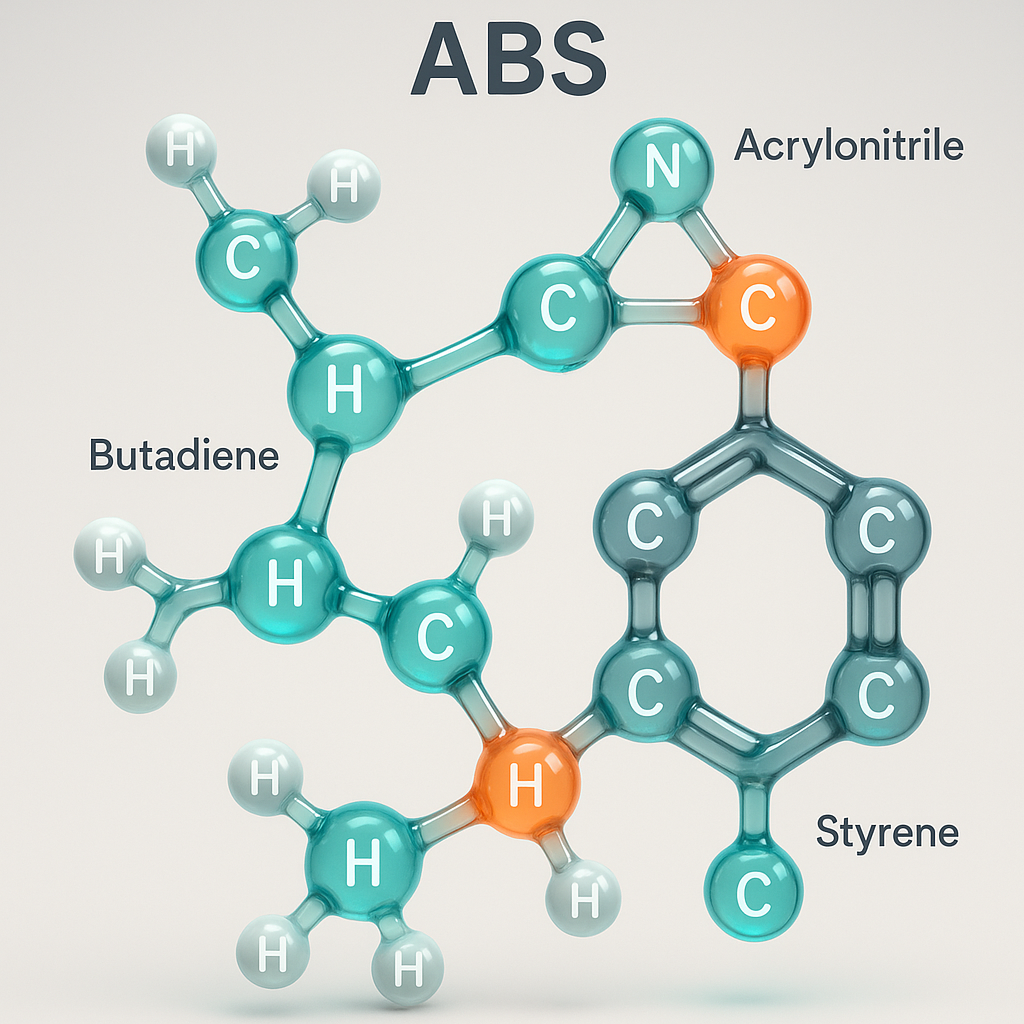
ABS is an amorphous thermoplastic copolymer built from three monomers working in synergy:
- Acrylonitrile (A): Provides chemical resistance, rigidity, and thermal stability.
- Butadiene (B): Introduces the elastomeric phase responsible for impact resistance and toughness at low temperatures.
- Styrene (S): Contributes flowability, surface gloss, and ease of processing.
The history of ABS dates back to the 1940s. The first commercial production was carried out by Borg-Warner Corporation in 1948, using an emulsion polymerization process. Through the 1950s and 1960s, the material gained exponential popularity due to its superior versatility compared to other thermoplastics of the era. Today, the global ABS market exceeds 30 million metric tons per year, making it one of the ten most produced engineering plastics in the world.
The typical monomer ratio in commercial ABS is approximately 15–35% acrylonitrile, 5–30% butadiene, and 40–60% styrene, though manufacturers adjust these proportions to create specialized grades with optimized properties.
Technical Properties of ABS
ABS stands out for offering a balance of properties that is difficult to match with a single polymer. The key technical values are:
| Property | Typical Value | Unit |
|---|---|---|
| Density | 1.03 – 1.07 | g/cm³ |
| Tensile strength | 40 – 50 | MPa |
| Tensile modulus | 1,700 – 2,800 | MPa |
| Izod impact strength (notched) | 150 – 400 | J/m |
| Heat deflection temperature (HDT 1.8 MPa) | 70 – 105 | °C |
| Continuous service temperature | -20 to +80 | °C |
| Mold shrinkage | 0.4 – 0.8 | % |
| Moisture absorption | 0.2 – 0.4 | % |
| Melt flow rate (MFR) | 1 – 30 | g/10 min |
| Rockwell hardness | R70 – R115 | — |
The amorphous structure of ABS (no defined melting point) allows a broad processing window, but also implies greater susceptibility to attack by certain solvents such as ketones, esters, and acetone. Its electrical insulation is excellent, with a typical dielectric strength of 15–20 kV/mm.
ABS Processing Parameters in Injection Molding
Correct machine setup is critical for defect-free parts. ABS requires mandatory pre-drying as it is hygroscopic. Recommended parameters:
Drying
- Drying temperature: 80°C for 2–4 hours in a dehumidifying dryer
- Maximum allowable residual moisture: < 0.1%
- Consequence of skipping drying: splay marks, voids, surface haziness, and reduced mechanical properties
Barrel Temperature Profile
| Zone | Recommended Temperature |
|---|---|
| Feed zone | 160 – 180 °C |
| Compression zone | 180 – 210 °C |
| Metering zone | 200 – 230 °C |
| Nozzle | 200 – 230 °C |
| Melt temperature | 210 – 240 °C |
Mold Temperature
- Range: 40 – 80 °C
- For high gloss finish: 60 – 80 °C
- For fast cycles: 40 – 50 °C
Injection
- Injection speed: Medium-high (avoid excessive speed causing shear degradation)
- Injection pressure: 70 – 130 MPa
- Holding (packing) pressure: 50 – 80% of injection pressure
- Holding time: 5 – 15 seconds depending on wall thickness
Plasticization
- Screw speed: 30 – 60 rpm
- Back pressure: 5 – 15 bar (promotes melt homogeneity)
Cooling and Cycle Time
- Cooling time: Function of wall thickness — general rule: 5 sec/mm of wall
- Ejection temperature: 60 – 80 °C
Screw L/D Ratio
- Recommended: 20:1 to 25:1 with compression ratio 2.0 – 2.5:1
Industrial Applications
of ABS
The versatility of ABS is demonstrated by the breadth of industries using it:
Automotive
- Instrument panels, door panels, mirror housings
- Front grilles, interior trim, handles
- Chrome-plated components (ABS accepts electroplating)
Consumer Electronics
- Housings for TVs, monitors, printers, and computers
- Keyboards, mice, remote controls
- Circuit breaker enclosures and electrical equipment housings
Toys
- LEGO® is the most iconic example of dimensional precision with ABS
- Action figures, building sets, educational toys
Home Appliances
- Vacuum cleaners, blenders, coffee makers, hair dryers
- Bodies of small kitchen appliances
Construction and Plumbing
- ABS pipes for drain, waste, and vent (DWV) systems (especially in North America)
- Fittings and connections for sanitary installations
Medical Devices
- Housings for non-implantable diagnostic equipment
- Trays, containers, and single-use devices
Additive Manufacturing (3D Printing FDM)
- ABS filament for FDM (Fused Deposition Modeling) printers
- Valued for strength and post-processing capability (sanding, painting, acetone smoothing)
ABS Grades and Variants
Commercial ABS is available in multiple specialized grades:
| Grade | Main Characteristics | Typical Applications |
|---|---|---|
| Standard ABS | Balanced general properties | Electronics, appliances |
| High-impact ABS | Higher butadiene content | Helmets, protective housings |
| Flame-retardant ABS (FR) | Halogenated or non-halogenated FR additives | Electrical enclosures, UL94 V0 |
| ABS + PC blend | Higher HDT, better impact | Automotive, premium electronics |
| UV-stabilized ABS | UV additives, no yellowing | Outdoor applications |
| High-heat ABS | HDT > 105 °C | Under-hood automotive |
| Transparent ABS | Copolymerization with SAN | Optics, displays |
| Recycled ABS (rABS) | Post-consumer reprocessed material | Non-critical applications |
Common Defects and Solutions in ABS Molding
Plant experience shows that ABS defects are highly predictable and correctable:
| Defect | Main Cause | Recommended Solution |
|---|---|---|
| Splay / silver streaks | Residual moisture > 0.1% | Dry properly at 80°C for 2–4h |
| Sink marks | Insufficient holding pressure | Increase packing pressure/time |
| Weak weld lines | Low temperature or slow fill | Raise melt temperature or injection speed |
| Warpage | Uneven mold cooling or early ejection | Balance cooling; increase cooling time |
| Burn marks (degradation) | Excessive temperature or high speeds | Reduce barrel temp or screw speed |
| Flash | Excessive pressure or worn mold | Reduce injection pressure; check clamp force |
| Dull/hazy surface | Low mold temperature | Increase mold temperature to 60–80°C |
| Jetting | Undersized gate or high speed | Enlarge gate; reduce initial injection speed |
Advantages and Disadvantages
 of ABS
| Advantages | Disadvantages |
|---|---|
| Excellent impact resistance | Poor UV resistance (yellows outdoors) |
| Good rigidity and tensile strength | Limited chemical resistance to organic solvents |
| Wide processing window | Lower heat resistance vs PC or PA |
| High-gloss surface with fine detail | Generates toxic smoke when burning |
| Easy to paint, plate, and bond | Surface scratch sensitivity |
| Moderate cost and wide availability | Absorbs more moisture than PP or PE |
| Compatible with many joining processes | Higher density than PP (heavier parts) |
Sustainability

and Recycling of ABS
ABS is identified with resin code #7 (Other plastics) in the resin identification coding system. Its recyclability depends on the method used:
Mechanical Recycling
The most industrially widespread method. It involves grinding, cleaning, and reprocessing post-consumer or production scrap ABS. Cost-efficient but can show incremental degradation of mechanical properties after multiple cycles, especially if the material has been UV-exposed or is contaminated with other polymers.
Chemical Recycling
An advanced technique that depolymerizes ABS back into its original monomers (acrylonitrile, butadiene, styrene). The resulting material is practically equivalent to virgin resin in properties. Although more expensive, it is the path toward a true closed loop and circular economy.
Bio-Based ABS
Active research aims to replace petrochemical-derived acrylonitrile with renewable sources. Some partially bio-based formulations are already commercially available.
Recycling Challenges
- Diversity of grades and formulations complicates separation
- Presence of flame retardants (especially halogenated) complicates reprocessing
- Cross-contamination with other polymers
- Accumulated thermal degradation over multiple reprocessing cycles
ABS vs Other Materials: Comparison
| Property | ABS | PC (Polycarbonate) | PP (Polypropylene) | HIPS |
|---|---|---|---|---|
| Impact resistance | High | Very high | Medium | Medium |
| Heat resistance (HDT) | 70–105°C | 110–145°C | 60–100°C | 60–80°C |
| Transparency | Opaque | Transparent | Opaque/semi | Opaque |
| UV resistance | Low | Medium | Medium-high | Low |
| Relative cost | Medium | High | Low | Low-medium |
| Processability | Very good | Good | Very good | Good |
| Surface finish | Excellent | Excellent | Good | Good |
| Chemical resistance | Medium | Medium-low | High | Medium |
| Mold shrinkage | 0.4–0.8% | 0.6–0.8% | 1.0–2.0% | 0.4–0.7% |
The ABS+PC blend combines the best of both: the impact resistance and HDT of polycarbonate with the processability and finish of ABS, widely used in automotive and premium electronics.
Conclusion
ABS is undoubtedly one of the pillars of modern plastic engineering. Its ability to adapt to multiple industries, combined with a cost-to-performance ratio that is hard to beat, keeps it as a reference material decades after its commercial introduction. Advances in mechanical and chemical recycling, along with the development of bio-based formulations, promise growing relevance in the context of the circular economy and sustainable manufacturing.
Mastering it on the shop floor — knowing its processing parameters, anticipating its defects, and selecting the right grade — is the difference between mediocre parts and export-quality production.
Join MoldingHub
Are you working with ABS or other materials in injection molding? MoldingHub is the global professional community built specifically for engineers, technicians, and companies in the plastics injection molding industry. Share your processing experiences, consult with experts, discover the latest developments in materials, and connect with professionals worldwide. Sign up for free and take your technical knowledge to the next level.