Polypropylene in Injection Molding: Complete Technical Guide
Polypropylene (PP) is undeniably one of the most important and versatile thermoplastics in the injection molding industry. From food containers to automotive components, from medical syringes to textile fibers, this material is present across virtually every industrial sector. In this complete technical guide, you will learn everything you need to know about PP: its molecular structure, history, types, properties, process parameters, common defects, and its role in the circular economy.
What is Polypropylene? Structure and Composition
Polypropylene is a semicrystalline thermoplastic produced by the addition polymerization of propylene (CH₂=CH-CH₃), a monomer derived from crude oil refining. The designation "semicrystalline" refers to the fact that its molecular structure combines ordered (crystalline) and disordered (amorphous) regions.
This structural duality is precisely what gives PP its unique balance of properties: the crystalline phase provides stiffness, chemical resistance, and service temperature, while the amorphous phase contributes toughness and impact resistance. The ratio between these two phases — determined primarily by the tacticity of the polymer chain — defines which type of PP we obtain.
Polypropylene tacticity:
- Isotactic (iPP): Methyl groups (-CH₃) are all arranged on the same side of the main chain. This is the commercially dominant form. High crystallinity (60-70%), greater stiffness and chemical resistance.
- Syndiotactic (sPP): Methyl groups alternate regularly on both sides. Intermediate properties, lower crystallinity than iPP.
- Atactic (aPP): Random distribution of methyl groups. Completely amorphous, rubbery, virtually no structural use; used as a modifier or adhesive.
The repeating unit of PP is -[CH₂-CH(CH₃)]- with a molecular weight in commercial grades ranging between 100,000 and 500,000 g/mol, depending on the polymerization process and end use.
History: Ziegler, Natta and the 1963 Nobel Prize
The history of polypropylene is inseparable from that of two brilliant scientists who revolutionized polymer chemistry in the 1950s.
In 1953, German chemist Karl Ziegler discovered that certain organometallic catalysts — compounds of titanium and aluminum — enabled ethylene polymerization at low pressures and temperatures, giving rise to high-density polyethylene (HDPE). This finding opened the door to a new era in polyolefin synthesis.
The following year, in 1954, Italian chemist Giulio Natta applied Ziegler's principles to propylene and succeeded in obtaining a polymer with a highly regular three-dimensional structure: isotactic polypropylene. Natta was the first to understand the relationship between the tacticity of the polymer chain and the macroscopic properties of the material. He coined the term "isotactic" and demonstrated that only this type of PP had mechanically exploitable industrial properties.
In 1957, the Italian company Montecatini began industrial production of PP under the Moplen brand, marking the beginning of the commercial era of polypropylene. Just six years later, in 1963, Ziegler and Natta jointly received the Nobel Prize in Chemistry for their discoveries in polymer chemistry and technology.
Since then, PP has grown to become the second most produced thermoplastic in the world — surpassed only by polyethylene — with global production exceeding 75 million tons per year.
Types of Polypropylene: Homopolymer, Copolymer, and Random
The market offers three main PP families, each optimized for different application requirements:
| Type | Composition | Crystallinity | Stiffness | Impact | Service Temp. | Transparency |
|---|---|---|---|---|---|---|
| Homopolymer (PP-H) | 100% propylene | High (65-70%) | High | Low (brittle in cold) | ~110-120°C | Low (opaque) |
| Block copolymer (PP-B) | Propylene + ethylene in blocks | Medium (55-65%) | Medium | High | ~100-110°C | Low (opaque) |
| Random copolymer (PP-R) | Propylene + distributed ethylene | Low (40-55%) | Medium-low | Medium | ~100°C | High (translucent) |
PP Homopolymer (PP-H): The purest and stiffest form. Excellent chemical and thermal resistance. Limited in applications requiring toughness at low temperatures (brittle temperature ~ -10°C). Ideal for structural parts, battery boxes, rigid pipes.
PP Block Copolymer (PP-B): The incorporation of polyethylene (PE) blocks into the chain dramatically improves impact resistance, especially at low temperatures (down to -20°C or -30°C with modifiers). It is the PP of choice for automotive parts, logistics boxes, bumpers, industrial containers.
PP Random Copolymer (PP-R): The random distribution of ethylene reduces crystallinity and makes the material more transparent. Widely used in hot water pipes, food containers, pharmaceutical bottles and applications where optical clarity matters.
Technical Properties of PP
Below is a summary of typical properties of homopolymer PP according to ASTM/ISO standards:
| Property | Typical Value | Standard |
|---|---|---|
| Density | 0.90 - 0.91 g/cm³ | ISO 1183 |
| Melt Flow Index (MFI) | 0.3 - 100 g/10 min | ISO 1133 |
| Tensile strength | 30 - 40 MPa | ISO 527 |
| Elastic modulus | 1,300 - 1,800 MPa | ISO 527 |
| Charpy impact (23°C) | 3 - 8 kJ/m² | ISO 179 |
| Heat Deflection Temp. (HDT 0.45 MPa) | 100 - 115°C | ISO 75 |
| Melting temperature (Tm) | 160 - 168°C | DSC |
| Glass transition temperature (Tg) | -10 to -20°C | DSC |
| Mold shrinkage | 1.5 - 2.5% | ISO 294 |
| Water absorption (24h) | < 0.02% | ISO 62 |
| Dielectric strength | 30 - 35 kV/mm | IEC 60243 |
PP has the lowest density among general-purpose thermoplastics (0.90 g/cm³), making it ideal when weight reduction is a key factor. Its virtually zero water absorption eliminates the need for pre-drying in most applications.
Process Parameters in Injection Molding
Mastering PP process parameters is essential to obtaining quality parts. The following are typical ranges for a standard-grade homopolymer PP:
| Parameter | Recommended Range | Notes |
|---|---|---|
| Hopper temperature | 40 - 60°C | Dry feed zone |
| Zone 1 (feed) | 190 - 210°C | Start of melting |
| Zone 2 (compression) | 200 - 230°C | Complete melting |
| Zone 3 (metering) | 210 - 240°C | Homogenization |
| Nozzle | 210 - 230°C | Avoid degradation |
| Mold temperature | 20 - 80°C | See notes |
| Injection pressure | 80 - 160 MPa | Geometry dependent |
| Holding pressure | 50 - 80% of peak | Compensate shrinkage |
| Injection time | 1 - 5 s | Part volume dependent |
| Holding time | 10 - 30 s | Until gate solidification |
| Cooling time | 15 - 40 s | Wall thickness dependent |
| Linear shrinkage | 1.5 - 2.5% | High — compensate in mold |
| Pre-drying | Not required | PP is non-hygroscopic |
| Screw speed | 50 - 150 rpm | Avoid thermal degradation |
| Back pressure | 5 - 15 MPa | Melt homogenization |
Mold temperature: A higher mold temperature (60-80°C) improves surface finish, reduces internal stresses and improves crystallinity — but increases cycle time. Lower temperatures (20-40°C) shorten the cycle but can generate residual stresses and warpage.
PP Shrinkage: PP shrinkage (1.5-2.5%) is significantly higher than ABS (0.4-0.8%) or nylon PA6 (0.8-1.5%). This high shrinkage must be compensated in mold design and can cause sink marks, warpage and distortion if not properly managed with holding and cooling parameters.
Industrial Applications by Sector
PP is the quintessential cross-sector material. Its combination of properties makes it useful across virtually every industrial sector:
Automotive (18% of global PP consumption):
- Bumpers (PP-B with impact modifiers)
- Instrument panels and cabin components
- Battery boxes and electrical component housings
- Ventilation grilles, center consoles
- Underbody protection and wheel arch liners
Packaging (35% of global PP consumption):
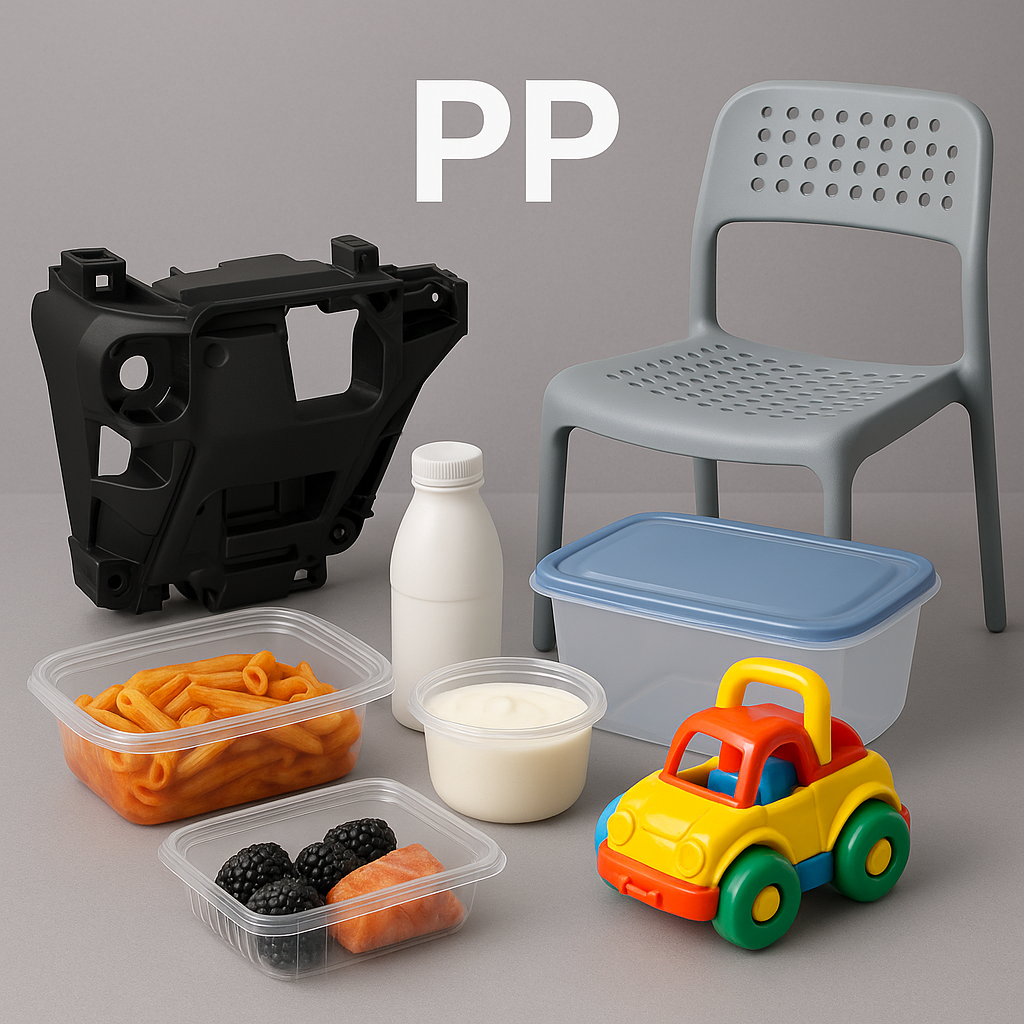
- Bottle caps and closures (PP is the king of caps)
- Food containers (yogurt, margarine, ready meals)
- Chemical product containers
- Cosmetic and pharmaceutical bottles
- Returnable packaging (milk crates, beverage crates)
Home and consumer goods:
- Garden furniture and plastic chairs
- Appliances (housings, internal components)
- Toys and sports goods
- Tableware and kitchen utensils (dishwasher safe)
Medical industry:
- Disposable syringes (PP is autoclavable at 121°C)
- Medication containers
- Laboratory equipment (tubes, pipettes, Petri dishes)
- Medical device components
Textile and nonwovens:
- Carpet and rug fibers
- Marine ropes and cordage
- Geotextiles for civil engineering
- Face masks and protective clothing (PP nonwovens)
Special Grades: Reinforced PP, Talc-filled PP, Glass Fiber PP
The PP family expands enormously with compound and reinforced grades:
| Grade | Filler/Modifier | Stiffness | Impact | HDT | Typical Application |
|---|---|---|---|---|---|
| Natural PP | — | 1,300-1,800 MPa | 3-8 kJ/m² | 110°C | General use |
| PP-T20 | 20% talc | 2,500-3,000 MPa | 2-5 kJ/m² | 120°C | Auto interior parts |
| PP-T40 | 40% talc | 3,500-4,500 MPa | 2-4 kJ/m² | 130°C | Dashboards, covers |
| PP-GF20 | 20% glass fiber | 4,500-5,500 MPa | 6-10 kJ/m² | 140°C | Structural parts |
| PP-GF30 | 30% glass fiber | 6,000-8,000 MPa | 7-12 kJ/m² | 150°C | Technical housings |
| PP-MD | Impact modifier | 1,000-1,500 MPa | 15-60 kJ/m² | 90°C | High-impact parts |
| PP-UV | UV stabilizer | Similar PP-H | Similar PP-H | 110°C | Outdoor, garden |
Talc reduces cost, improves stiffness and HDT, and reduces PP shrinkage. It is the most commonly used filler in automotive interior parts. However, it impairs surface finish and impact resistance.
Short glass fiber (GF) dramatically increases stiffness and HDT but increases anisotropy — the part shrinks differently in the flow direction vs. transverse direction — which complicates mold design and can generate greater warpage.
Common Defects and Solutions in PP
| Defect | Main Cause | Solution |
|---|---|---|
| Sink marks | High shrinkage without sufficient holding | Increase holding pressure/time; reduce wall thickness; add ribs |
| Warpage | Differential shrinkage, non-uniform cooling | Balance mold temperature; increase mold temperature; review design |
| Flow lines | Low temperature, low speed | Increase barrel/mold temperature; increase injection speed |
| Burn marks | Thermal degradation, trapped gases | Reduce temperature; add vents; reduce final-stage speed |
| Flash | Excessive pressure or worn mold | Reduce injection pressure; verify clamp force |
| Low-temperature brittleness | PP-H without modifier in cold conditions | Switch to copolymer PP; add elastomer |
| Tiger stripes / banding | Unstable flow in HFR grades | Optimize mold temperature and speed; use hot runner |
| Silver streaks | Surface moisture or degraded material | Pre-dry; purge screw; lower nozzle temperature |
Advantages and Limitations of PP
| Aspect | Advantages | Limitations |
|---|---|---|
| Cost | One of the most economical on the market | — |
| Density | Lowest among common thermoplastics (0.90 g/cm³) | — |
| Chemical | Excellent resistance to acids, bases, organic solvents | Sensitive to aromatic and chlorinated hydrocarbons |
| Fatigue | High flexural fatigue resistance (living hinges) | — |
| Temperature | Up to 120-130°C in continuous service | Not suitable for continuous service > 130°C |
| UV | — | Degrades under UV radiation without stabilizer |
| Adhesion | — | Difficult to bond and paint (requires corona/plasma treatment) |
| Cold impact | — | PP-H brittle at subzero temperatures |
| Shrinkage | — | High (1.5-2.5%): requires mold compensation |
| Processability | Excellent flowability, fast cycles | — |
Sustainability: Recyclability and Recycled PP
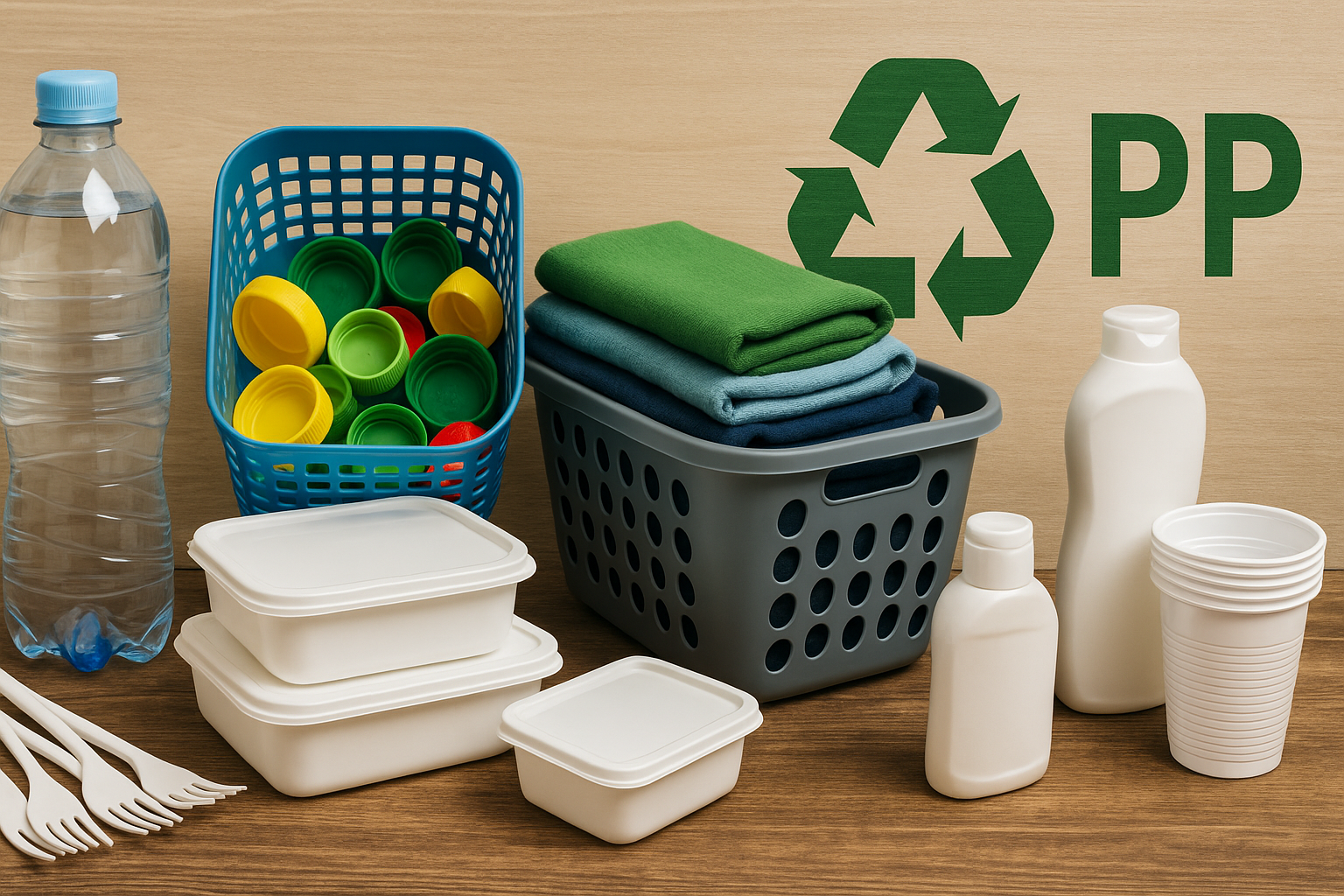
Polypropylene is 100% recyclable and is identified with recycling symbol No. 5 (♺5). Its mechanical recycling — shredding, washing, extrusion — is well established industrially and allows the production of recycled pellets (rPP) with acceptable properties for many applications.
Environmental advantages of PP:
- PP production requires less energy than many engineering plastics
- Its low density means less material per part → lower carbon footprint per kilogram of part
- High post-industrial recycling rate (clean process waste)
PP recycling challenges:
- Color and additive contamination makes post-consumer recycling difficult
- Blends with other polymers (PP + EPDM + talc) require prior separation
- rPP has reduced mechanical properties compared to virgin PP
Trends: Major automotive and packaging producers are increasing recycled content targets (30-50% rPP in new platforms). Chemical recycling technology (pyrolysis) can recover high-purity propylene monomer, closing the material cycle.
Comparison PP vs PE vs ABS
| Property | PP | HDPE | ABS |
|---|---|---|---|
| Density (g/cm³) | 0.90-0.91 | 0.94-0.97 | 1.02-1.08 |
| Relative cost | Very low | Low | Medium |
| Stiffness (MPa) | 1,300-1,800 | 800-1,400 | 1,700-2,800 |
| Impact resistance | Medium | High | High |
| Service temperature | 110-120°C | 90-110°C | 85-100°C |
| Chemical resistance | Very high | High | Medium |
| Surface finish | Good | Good | Excellent |
| Mold shrinkage | 1.5-2.5% | 1.5-3.0% | 0.4-0.8% |
| Recyclability | High | High | Medium |
| UV resistance | Low (no additive) | Low (no additive) | Low (no additive) |
| Adhesion/painting | Difficult | Difficult | Easy |
| Typical application | Auto, packaging, medical | Pipes, large containers | Electronic housings |
PP is the winning choice when prioritizing low weight, low cost, high chemical resistance and recyclability. ABS excels in surface finish, dimensional stability and adhesion, making it the favorite for consumer electronics. HDPE dominates in pressure pipes and large containers thanks to its better impact at low cost.
Conclusion
Polypropylene is today the most versatile and ubiquitous thermoplastic in the injection molding industry. Its unique combination of lightness, chemical resistance, recyclability, low cost and excellent processability has made it the reference material for sectors as diverse as automotive, packaging, medicine and home goods.
A deep understanding of its molecular structure, the types available, its technical properties and — above all — the correct process parameters is the difference between a defective part and a quality component. High shrinkage and cold sensitivity are its main limitations, but both have solutions with the correct grade and appropriate process parameters.
The future of PP is shaped by grades with higher recycled content, ultra-low-weight formulations for electromobility and bio-based compounds seeking to reduce dependence on fossil petroleum.
Join MoldingHub
Do you work with polypropylene in your production plant? Do you have questions about process parameters, defects or grade selection? MoldingHub is the global social network for injection molding professionals where you can share experiences, solve technical problems and connect with experts from around the world.
Post your process cases, consult the community, discover material and machinery suppliers, and stay up to date with the latest industry news. Sign up for free at MoldingHub and take your technical knowledge to the next level.