Glitter Contamination in Injection Molding: How to Eliminate It with Chemical Purging
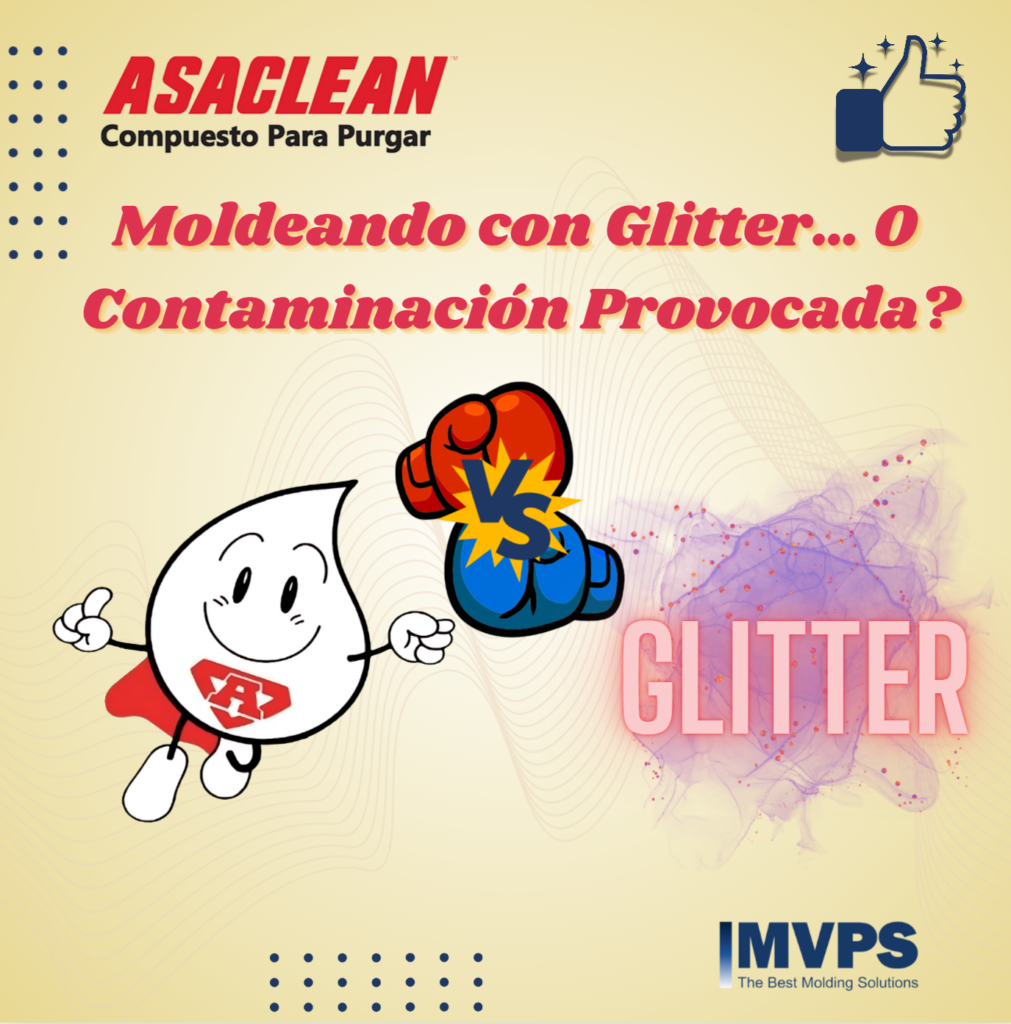
In the injection molding industry, color changes are among the most expensive and technically demanding operations in the production process. When the previous material contains glitter or sparkle particles, the challenge multiplies: these metallic microplastics adhere to barrel walls, screws, and nozzles with surprising tenacity, contaminating dozens or hundreds of parts in the next batch before disappearing completely. This article presents a real case study, documented by ASACLEAN Mexico, demonstrating how it is possible to eliminate glitter contamination from the very first shot using a high-efficiency chemical purging compound — saving more than 9 hours of weekly production time and completely eliminating mechanical barrel cleaning.
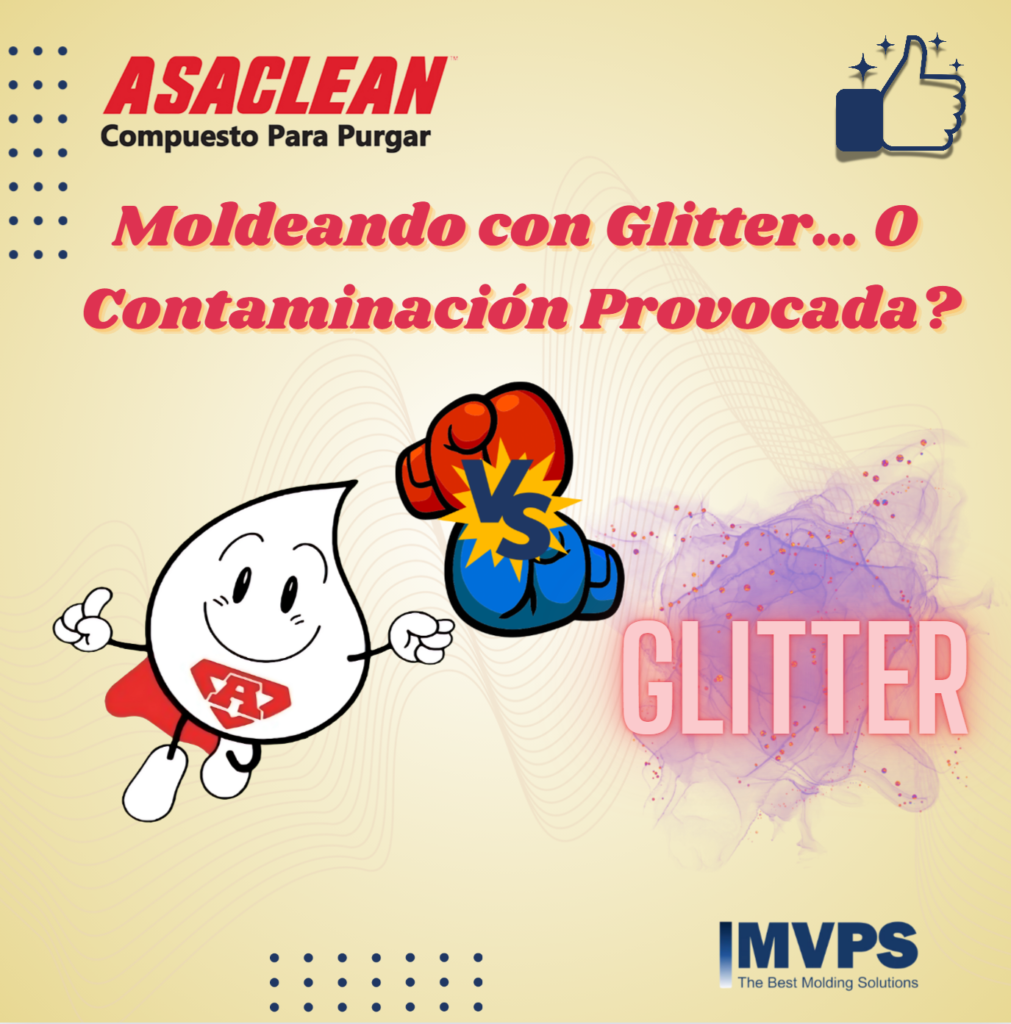
What is glitter and why does it contaminate the process?
Glitter is a material composed primarily of polyester and aluminum sheets cut into fragments smaller than 5 mm. The WHO classifies it as a microplastic precisely because of this reduced size, which gives it unique physical properties: it is lightweight, reflective, and possesses electrostatic adhesion capacity that makes it extremely difficult to remove from hot metal surfaces.
In the injection molding process, glitter is incorporated as an additive to the base polymer (usually polypropylene, ABS, TPE, or nylon) to give a brilliant visual effect to the finished product. The metallic particles must be distributed homogeneously in the melt to achieve the desired visual effect, but this same homogeneity is what complicates subsequent cleaning.
Why is it so difficult to remove? Glitter particles:
- Become embedded in screw flights and dead zones in the head
- Withstand process temperatures without degrading (aluminum melting point: 660°C)
- Their flat geometry allows them to slide between mechanical barrel tolerances
- Static electricity generated during the process strongly adheres them to metal surfaces
- They get trapped in low-flow areas such as the metering zone and check valve
History of glitter: from industrial waste to microplastic
Few materials have an origin story as pragmatic as glitter. In the 1930s, German immigrant Henry Ruschmann developed a machine in New Jersey to cut waste materials into tiny fragments as an economical alternative to silver and gold metallic powders used in decoration.
What started as an avant-la-lettre circular economy solution became a ubiquitous material in the 20th century plastics industry. Today, glitter is present in:
- Textiles and clothing (sequins, metallic threads)
- Cosmetics (makeup, nail polish, body creams)
- Decorative plastic packaging and packaging
- Toys and stationery items
- Technical parts where visual finish is relevant
Scientists at Cambridge University are currently developing plant-based biodegradable glitter, suitable even for food and cosmetic applications, in response to growing regulatory pressure on microplastics.
The glitter problem in color and material changes
For a plastics processor, the real problem with glitter lies not in producing the sparkly parts, but in what happens when you need to change material or color.
Consider this typical scenario: a 200-ton machine has been running three shifts producing black polypropylene caps with 4% silver glitter. The next order requires producing transparent crystal PP bodies for cosmetic containers. Each piece with a visible glitter particle is an immediate quality control rejection.
Without proper purging, the traditional process of glitter elimination involves:
- Purging with production material until parts come out clean (minimum 200-400 shots)
- Visual inspection of each part, often with a magnifying glass for transparent materials
- In extreme cases, disassembly and mechanical cleaning of the barrel and screw
- Startup testing until zero contamination is confirmed
This process can consume between 2 and 4 hours per change, with material waste that can exceed 50 kg in medium-sized machines.
Economic impact: rejected parts and lost time
The real impact of glitter contamination is rarely precisely quantified in the plant. The following table estimates the cost per contamination event in a standard machine:
| Concept | Traditional Method | With Chemical Purge |
|---|---|---|
| Scrap parts per change | 300 parts | 0 parts |
| Change-over time | 60-90 min | 30 min |
| Mechanical barrel cleaning | 2-4 h/week | 0 h |
| Purge material consumed | 30-50 kg virgin resin | 1-2 kg compound |
| Customer delivery risk | High | Minimal |
| Technical team frustration | High | Low |
If a plant performs 3 glitter changes per week using the traditional method:
- 900 scrap parts × cost per part
- 4.5 hours of unproductive time
- 90-150 kg of wasted virgin resin
- Potential for unplanned downtime due to customer claims
With a chemical purging compound like Asaclean Grade PLUS, the numbers change radically. The case documented by ASACLEAN Mexico reported savings of 540 minutes per week (9 additional production hours) and the complete elimination of 300 scrap parts per batch.
The challenge: eliminating glitter without dismantling the barrel
The question posed by Ing. Mario de León, ASACLEAN's national representative, was deceptively simple: can we eliminate glitter from the very first shot without dismantling the barrel?
The technical challenge is considerable. For a purge to be effective against glitter, it must:
- Physically penetrate into the low flow-rate zones where glitter accumulates
- Create sufficient mechanical friction to dislodge particles adhered to metal surfaces
- Act as a carrier that sweeps glitter out of the barrel without re-depositing
- Be effective at process temperatures of the production material (170-240°C for PP)
- Not contaminate the next production batch with purging compound residues
Traditional glitter elimination methods (purging with production material or mechanical cleaning) do not satisfy all five requirements simultaneously. Production material lacks the necessary mechanical action; mechanical cleaning satisfies all criteria but requires stopping the machine and dismantling the barrel.
Solution: purging with Asaclean Grade PLUS + HDPE
Asaclean Grade PLUS is a super-concentrated chemical purging compound specifically designed to remove difficult contaminants from barrels and screws. Its action mechanism combines:
- Chemical action: active agents that weaken contaminant adhesion to metal surfaces
- Amplified mechanical action: the compound expands its volume inside the barrel, increasing contact pressure with the walls
- High-flow carrier: efficiently sweeps released contaminants out of the barrel
Protocol used in the case study:
- Blend of HDPE + 20% Asaclean Grade PLUS as purge vehicle
- Barrel temperature: production PP process conditions
- Purge cycles: continuous until complete purge
- Separation material: pure HDPE resin to displace the compound before starting production
The choice of HDPE as carrier is not coincidental: its high internal friction coefficient and melt viscosity generate the shear forces necessary to drag glitter metallic particles, while its low cost makes it economically viable as a separation material.
Case study: quantified results
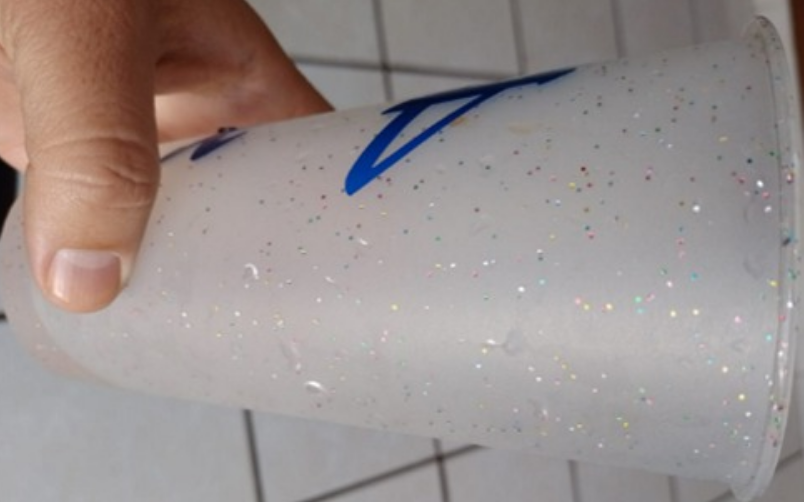
The case was documented at an injection molding facility in Mexico. The machine needed to change from black PP with 4% glitter to transparent crystal PP.
Before chemical purging (traditional method):
| Metric | Value |
|---|---|
| Scrap parts needed to clean | 300+ parts |
| Material change-over time | 60-90 minutes |
| Mechanical barrel cleaning frequency | Regular |
| Contamination risk in production | High |
| Unproductive hours per week (3 changes) | 3-4.5 hours |
After implementing Asaclean Grade PLUS:
| Metric | Value |
|---|---|
| Scrap parts needed | 0 parts (clean from first shot) |
| Material change-over time | 30 minutes |
| Mechanical barrel cleaning | Eliminated |
| Contamination risk | Minimal |
| Weekly time savings (3 changes) | 540 minutes (9 hours) |
Additional reported benefits:
- Elimination of technical team frustration with difficult color changes
- Reduction of customer delivery delays due to contamination
- Release of the maintenance department from unplanned mechanical cleanings
- Greater production team confidence in post-changeover startups
Step-by-step protocol for purging glitter
Based on the case study and ASACLEAN best practices, the following protocol can be adapted to most PP, ABS, or nylon installations with glitter contamination:
STEP 1 — Initial displacement purge
- Empty the barrel of glitter-containing production material
- Use the same base material (without glitter) to displace as much of the pigmented plastic as possible
STEP 2 — Prepare the purge mixture
- Blend HDPE + 20% Asaclean Grade PLUS in hopper or manually
- Verify that barrel temperature is compatible with HDPE (minimum 180°C in melt zone)
STEP 3 — Active purging
- Introduce the purge mixture
- Perform injection cycles at medium dosage (do not fill mold, only purge outward)
- Continue until material coming out of the barrel is completely free of glitter particles
- Typically: 3-7 purge cycles depending on barrel capacity
STEP 4 — Separation purge
- Introduce pure HDPE to displace Asaclean compound residues
- 2-3 cycles are sufficient for medium machines (<500 ton)
STEP 5 — Production startup
- Introduce new production material
- The first shot should already be free of glitter contamination
- Visually inspect the first shot before starting automatic cycle
Important considerations:
- Results may vary depending on material type, screw geometry, and machine specifications
- Consult with ASACLEAN technical representative to adapt the protocol to your specific process
- Maintain purging compound stock to guarantee immediate availability
Biodegradable glitter: sustainable alternatives
Regulatory pressure on microplastics is driving the development of more sustainable alternatives to conventional glitter. The most relevant advances for the molding industry include:
Plant cellulose glitter: Researchers at Cambridge University have developed glitter from nanocrystalline cellulose derived from woody plants. This material reproduces the iridescent effect of conventional glitter through structural color structures (without metallic pigments) and is completely biodegradable.
Impact on the molding process: Next-generation biodegradable glitters have lower thermal degradation points than conventional aluminum, which may require process temperature adjustments. However, their cleaning behavior in the barrel is significantly more favorable than traditional metallic glitter.
Evolving global regulation: The European Union restricted microplastics in cosmetics and environmentally released applications in 2023. This regulatory trend is progressively extending to other sectors and regions, making adoption of biodegradable alternatives a medium-term competitive advantage.
Recommendations for production planning with glitter
For production managers and process technicians who regularly work with glitter-containing materials, the following recommendations can significantly reduce operational impact:
1. Color sequence planning
- Group glitter production at the end of each shift or before planned shutdowns
- Schedule glitter-to-transparent or light-colored changes always with purging compound available
- Avoid glitter-to-white or crystal changes without an established purging protocol
2. Purge inventory management
- Maintain minimum purging compound stock equivalent to 2 changes per susceptible machine
- Establish automatic reorder point to avoid shortages during production peaks
3. Technical team training
- Train operators and technicians in the chemical compound purging protocol
- Document the specific process for each machine in the production management system
- Include purging time in total cycle time estimates for order changes
4. Efficiency tracking
- Document the number of scrap shots before and after implementing chemical purging
- Calculate monthly ROI of purging compound vs. wasted material
- Use this data to justify investment to management
5. Customer communication
- Include purging time in delivery timelines when complex color changes are involved
- Establish additional inspection protocols for the first batches after glitter color changes
Conclusion
Glitter contamination in injection molding is a real problem that affects productivity, quality, and profitability at thousands of processing plants worldwide. Its effective elimination requires a solution that combines chemical and mechanical action simultaneously — something that production material purges cannot provide.
The case study documented by ASACLEAN Mexico demonstrates that it is possible to completely eliminate glitter contamination from the very first shot using an HDPE + 20% Asaclean Grade PLUS blend. The quantified results speak for themselves: zero scrap parts, 30-minute change-over time, and 9 additional production hours per week.
In a manufacturing environment where every minute of production has direct economic value, investing in a specialized chemical purging protocol for glitter is not an optional expense but a competitiveness tool.
Join MoldingHub
Do you work with glitter-containing materials or other difficult-to-purge additives? MoldingHub is the global professional network for the injection molding industry where thousands of technicians, engineers, and production managers share case studies, technical solutions, and process experiences in real time.
Connect with experts like Ing. Mario de León, discover the latest purging solutions, and share your own success stories with the most specialized community in the plastics sector. Join free at MoldingHub and take your technical knowledge to the next level.