Einar 201 at Novatec Pagani: –10°C Barrel Temperature, –20% Amperage, Zero Black Lines
On July 2, 2024, the MoldingVPS team visited León, Guanajuato to conduct trials of the Einar 201 additive in collaboration with GEA Biodegradables at Novatec Pagani, a national leader in plastic containers manufacturing. The results were conclusive: 10°C reduction in barrel temperature profile, 20% decrease in amperage, and complete elimination of black line defects. Here is the full technical analysis of this industrial case study.
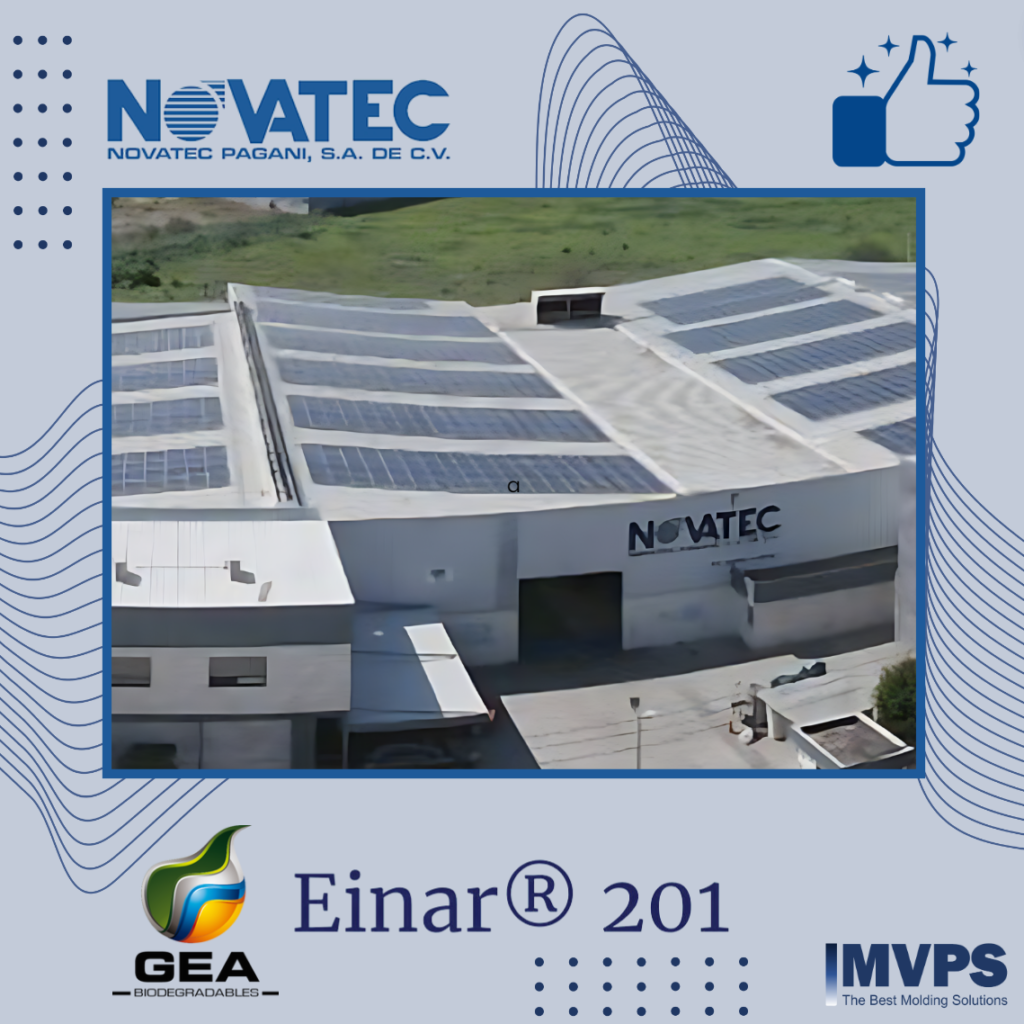
Novatec Pagani: Mexico's Leading Plastic Container Manufacturer
Novatec Pagani is a nationally recognized Mexican company and one of the most important plastic containers and recipients manufacturers in the country. Their portfolio covers containers of every type, size, material and color, serving food, pharmaceutical, cosmetic, and industrial sectors.
With high-cadence production lines and multiple molding technologies — injection, blow molding, and rotomolding — Novatec Pagani represents exactly the type of company where process optimization has a direct and measurable economic impact. Every tenth of a degree, every percentage point of amperage reduction, and every eliminated defective part translates into thousands of dollars in monthly savings.
It was in this high-volume, technically demanding context that the Einar 201 additive trials were conducted, demonstrating that improvements are not theoretical but quantifiable under real industrial production conditions.
What Is Einar 201 and How Does It Work?
Einar 201 is a processing additive for plastics developed by GEA Biodegradables, formulated specifically to improve melt flow and reduce internal friction in the barrel, screw, and mold during thermoplastic processing.
Unlike conventional lubricants, Einar 201 acts as a plant-based processing agent, radically differentiating it from traditional petrochemical additives. Its main action mechanism consists of:
- Reducing the effective viscosity of the molten polymer without altering the final mechanical properties of the part
- Decreasing friction at the metal-polymer interface, lowering the energy demand on the screw
- Improving dispersion of pigments and masterbatches within the melt
- Eliminating carbonized deposits (source of black lines) from inside the barrel
- Facilitating flow in complex geometries and thin sections
The additive is incorporated into the process at very low concentrations (typically 0.5%–1.5%), mixed directly with the base material in the hopper. It requires no special equipment or significant process modifications.
Properties and Certifications of Einar 201
One of the most relevant aspects for the industry is the regulatory framework supporting Einar 201, especially for applications in food or pharmaceutical packaging.
| Certification / Property | Detail |
|---|---|
| FDA | Approved for food contact |
| RoHS | Free from restricted hazardous substances |
| REACH | Compliant with European chemicals regulation |
| Origin | Plant-based, 100% environmentally friendly |
| Compatibility | HDPE, LDPE, PP, ABS, PET, PS, PVC and blends |
| Typical dosage | 0.5% – 1.5% by weight on base material |
| Presentation | Granules or powder, easy hopper incorporation |
| Shelf life | Stable under normal storage conditions |
The FDA certification is especially valuable for Novatec Pagani, which produces containers for the food industry. Being able to improve the process without compromising product safety is a non-negotiable requirement in that segment.

Trial Setup: Virgin HDPE + Einar 201 at 0.8%
Trial conditions were rigorously defined to ensure reproducible results representative of Novatec Pagani's actual production process.
Base material: Virgin HDPE (high-density polyethylene) Additive: Einar 201 at 0.8% by weight Masterbatch: Production colorant Cavity configuration: 2+2 (four total cavities) Part weight: 40 grams (including runner, sprue, and complete feed system) Process: Industrial injection molding
Working with virgin HDPE as the base guarantees that any improvement observed is directly attributable to the Einar 201 additive and not to variations in recycled material. The colorant was added to also evaluate the additive's impact on chromatic dispersion, one of the most frequent problems in multicolor parts or those with high-concentration masterbatch.
The choice of 0.8% as the trial concentration reflects GEA Biodegradables' philosophy: demonstrating efficacy at conservative dosages, where the additive cost is minimal and the process impact is maximum.
Process Parameters Before and After Einar 201
The following table summarizes the parameter modifications made during the trial. Notably, adjustments were minimal — less than 1% from the original process — validating that Einar 201 acts transparently over the existing process:
| Parameter | Before Einar 201 | After Einar 201 | Change |
|---|---|---|---|
| Zone 1 temperature | T baseline | T baseline – 10°C | –10°C |
| Zone 2 temperature | T baseline | T baseline – 10°C | –10°C |
| Zone 3 temperature | T baseline | T baseline – 10°C | –10°C |
| Zone 4 temperature | T baseline | T baseline – 10°C | –10°C |
| Nozzle temperature | T baseline | T baseline – 10°C | –10°C |
| Amperage (injection) | 100% reference | 80% reference | –20% |
| Amperage (recovery) | 100% reference | 80% reference | –20% |
| Injection pressure | No significant change | No significant change | <1% |
| Injection speed | No significant change | No significant change | <1% |
| Cycle time | No significant change | No significant change | <1% |
All other injection process parameter adjustments remained below 1% from the original process, confirming the additive's efficiency and process transparency.
Quantified Technical Results
The trial results at Novatec Pagani were measured and documented with technical rigor. The following table presents the key metrics:
| Metric | Before | After | Improvement |
|---|---|---|---|
| Barrel temperature (all zones) | T reference | –10°C (–18°F) | 10°C/zone reduction |
| Amperage consumption (injection) | 100% | 80% | –20% |
| Amperage consumption (recovery) | 100% | 80% | –20% |
| Black line defect | Present | Eliminated | 100% elimination |
| Color dispersion | Inconsistent | Uniform and satisfactory | Qualitative improvement |
| Destructive tests | Variable | Within nominal tolerances | Full compliance |
| Additional parameter adjustments | — | <1% from original | Minimal intervention |
These results are especially significant because they were obtained under real industrial production conditions, with equipment the technician had no prior knowledge of (new machine, mold, and material), which represents the most demanding scenario possible for demonstrating additive robustness.
Barrel Temperature Reduction: –10°C Across All Zones
One of the most impactful improvements was the uniform 10°C (18°F) reduction across all barrel zones, including the nozzle. This reduction was neither marginal nor localized — it was applied consistently throughout the entire thermal profile.
Why does lowering barrel temperature matter?
- Reduced thermal degradation: At lower temperatures, HDPE suffers less oxidative degradation, directly eliminating the formation of carbonized compounds that generate black lines.
- Direct energy savings: Barrel electric heaters work less to maintain the target temperature. In a continuous production machine, a 10°C difference can represent a 5%–8% reduction in heating energy consumption.
- Extended equipment life: Lower temperature = less thermal stress on screw, barrel, check rings, and nozzle.
- Potential cycle time reduction: By injecting material at lower temperature, the time the part needs in the mold to solidify may be reduced, shortening the cycle.
- Better surface quality: Less degraded material produces cleaner surfaces, free of burns or yellowish deposits.
In the context of Novatec Pagani, with multiple machines running continuous shifts, this energy impact is multiplied by the number of injection machines in production.
Amperage Reduction: –20% in Injection and Recovery
The 20% reduction in amperage consumption during injection and recovery phases is perhaps the most tangible result from an economic standpoint. Amperage is a direct indicator of the injection machine motor's electrical consumption.
Technical interpretation:
During the injection phase, the machine's hydraulic or electric motor must overcome the viscous resistance of the molten polymer to push it through the filling system. A more fluid material (thanks to Einar 201) requires less force, directly translating to lower amperage.
During the recovery phase (plasticization), the screw must melt and homogenize the material. With Einar 201, metal-polymer friction is reduced, the screw rotates with less resistance, and the motor consumes less energy.
Economic savings estimation:
Assuming an injection machine with 15 kW combined consumption during injection and recovery, at 20 hours of daily production and an electricity cost of $0.15 USD/kWh:
- Daily consumption without additive: 15 kW × 20 h = 300 kWh → $45 USD/day
- Daily consumption with Einar 201: 12 kW × 20 h = 240 kWh → $36 USD/day
- Daily savings per machine: $9 USD
- Monthly savings per machine: ~$270 USD
In a plant with 10 machines operating, potential monthly savings exceed $2,700 USD, which in most cases far exceeds the cost of the additive used.
Defect Elimination: Black Lines and Color Dispersion
Two of the most costly and difficult defects to solve in HDPE molding with colorant are black lines and irregular color dispersion. The trial at Novatec Pagani demonstrated the total elimination of both.
Black Lines: Origin and Solution
Black lines (also called black streaks) are one of the most frequent defects in injection molding. Their main origin:
- Thermally degraded material adhering to barrel walls
- Dead spots where polymer remains at high temperature for extended periods
- Hot spots in the nozzle or hot runner channels
- Residues from previous purging not completely eliminated
Einar 201 acts on this defect through two simultaneous mechanisms:
- Reduces process temperature, minimizing thermal degradation at source
- Acts as a mild cleaning agent, helping to loosen and purge carbonized deposits from internal walls
The result at Novatec Pagani was the complete elimination of this defect, preventing scrap, reprocessing, and machine downtime for deep purging.
Color Dispersion: Guaranteed Uniformity
The improvement in colorant masterbatch dispersion is a direct consequence of the better rheological behavior of HDPE with Einar 201. A more fluid and homogeneous polymer distributes pigment particles more uniformly, resulting in:
- Greater color consistency batch to batch
- Less tonal variation between parts from the same cavity
- Possibility of reducing masterbatch concentration (additional savings)
- Better visual appearance on the part surface
Economic Analysis: Energy Savings and Productivity Gains
Summary of Identified Economic Benefits
| Savings Source | Mechanism | Estimated Impact |
|---|---|---|
| –20% amperage reduction | Lower motor electrical consumption | High |
| –10°C barrel temperature reduction | Lower heater consumption | Medium-High |
| Black line elimination | Reduced scrap and reprocessing | Medium |
| Better color dispersion | Possible masterbatch % reduction | Medium |
| Less material degradation | Extended screw and barrel life | Low-Medium |
| Fewer purging stoppages | Less unproductive downtime | Medium |
Einar 201 Cost vs. Benefit
At a dosage of 0.8% on the weight of processed material, the additive cost per kilogram of final product is marginal. Considering that the energy savings identified in a single production shift are significant, the ROI (return on investment) of Einar 201 is typically positive within the first month of use.
When to Use Einar 201 in Your Molding Process?
Based on the Novatec Pagani case results and the product's technical specifications, Einar 201 is especially recommended when:
- Black lines or dark streaks appear recurrently in parts
- Colorant or masterbatch dispersion is irregular between cavities or cycles
- Plant energy consumption is high and savings are sought without investing in new machinery
- Working with high-viscosity materials such as HDPE, PP, LDPE, ABS, or complex blends
- Seeking to increase the percentage of recycled material without compromising final quality
- Flow problems exist in molds with complex geometries, thin walls, or long channels
- Processing sensitive materials where barrel temperature must be kept as low as possible
- Looking for an ecological alternative to petrochemical-based process additives
Einar 201 is compatible with injection molding, blow molding, and rotomolding, expanding its applicability throughout the entire plastics production chain.

Conclusion: Einar 201 Proves Its Value Under Real Industrial Conditions
The case study at Novatec Pagani is a paradigmatic example of how a well-formulated processing additive can transform the performance of an existing production line without the need for investment in new machinery or radical process changes.
The results speak for themselves:
- –10°C across the complete barrel temperature profile
- –20% amperage in injection and recovery
- Complete elimination of black lines
- Uniform and satisfactory color dispersion
- Destructive tests within nominal tolerances
- Process adjustments below 1%
The combination of certifications (FDA, RoHS, REACH), plant-based origin, demonstrated efficacy at low dosage, and compatibility with multiple resins and processes positions Einar 201 as an essential optimization tool for any molding plant seeking efficiency, quality, and sustainability.
Join MoldingHub: The Global Injection Molding Community
Want to share your own experiences with process additives, learn about results from other plants, or connect with HDPE, LDPE, PP, and other resin experts?
MoldingHub is the professional social network designed exclusively for the injection molding industry. Here you'll find:
- Real case studies from plants in Mexico, Latin America, and worldwide
- Technical calculations: viscosity, process window, cavity balance, cooling time, and more
- Supplier directory for resins, machines, molds, and additives
- Troubleshooting forum: share your defect and receive guidance from the community
- MoldingIA: artificial intelligence assistant specialized in injection molding
Register for free on MoldingHub and take your process optimization to the next level.